Are you tired of running out of hot water in the middle of a shower? Do you dread opening your energy bill every month? If you are still using an old, rusty water heater tank, you are literally paying to heat water you aren’t even using.
There is a better way. It is called a tankless water heater.
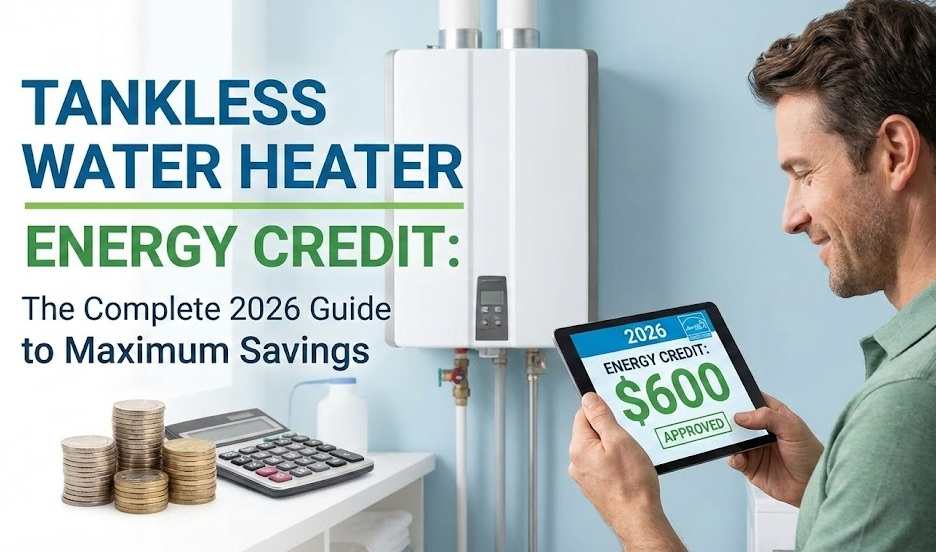
Not only does this technology give you endless hot water and lower monthly bills, but the government is also currently offering to pay for a big chunk of the upgrade. Thanks to the Energy Efficient Home Improvement Credit, you can get money back at tax time just for making your home more efficient.
This guide will walk you through everything you need to know about the tankless water heater energy credit. We will cover how much money you can get, which models qualify, and exactly how to claim your cash.
What is the Tankless Water Heater Tax Credit?
The federal government wants to help you save energy through the Inflation Reduction Act, which created the Energy Efficient Home Improvement Credit (Section 25C) to reward homeowners for upgrades like tankless water heaters. This straightforward incentive allows you to claim a tax credit equal to 30% of your total project cost, including both the price of the unit and the installation labor, up to a maximum limit of $600. For example, if your total expense is $2,000, the 30% calculation hits the $600 cap, giving you a dollar-for-dollar reduction on the federal taxes you owe rather than just a deduction on your income. This credit is available right now for any qualifying equipment installed between January 1, 2023, and December 31, 2032, offering a long-term opportunity to lower your tax bill while reducing your monthly energy costs.
Who is Eligible for the Credit?
Not every home and not every person qualifies. Before you rush out to buy a new unit, let’s make sure you check the right boxes.

The Must-Haves Checklist:
- Existing Home: You must install the heater in an existing home. New construction (building a brand new house) does not qualify for this specific credit.
- Primary Residence: The home must be where you live most of the time. You cannot claim this for a rental property you own but don’t live in. (Landlords, this one isn’t for you unless you live there too).
- United States: The home must be located in the U.S.
- Tax Liability: This is a non-refundable credit. That means it can reduce the taxes you owe to $0, but the government won’t send you a check for the difference if the credit is bigger than your tax bill.
Does Income Matter?
For the federal tax credit, there is generally no income limit. Whether you make $50,000 or $500,000, you can claim the Section 25C credit if you have tax liability.
(Note: There are separate state “rebates” that do depend on income, which we will discuss later in this article.)
Which Tankless Water Heaters Qualify?
This is the most critical section. Not all tankless water heaters get the tax credit. If you buy a cheap, inefficient unit, you will get $0 back from the IRS.
To get the credit, your new water heater must meet strict efficiency rules. The government uses a rating called UEF (Uniform Energy Factor) to measure efficiency. The higher the UEF, the more efficient the unit.
The Magic Numbers for Gas Tankless
To qualify for the $600 credit, a gas-fired tankless water heater must be ENERGY STAR certified and have a UEF rating of 0.95 or higher. A UEF of 0.95 means the unit is 95% efficient, so for every dollar you spend on gas, $0.95 goes directly into heating water and only $0.05 is wasted, which is a massive improvement over old tank heaters that are often only 60% efficient and waste 40 cents of every dollar.
What About Electric Tankless?
This is a common point of confusion, but the reality is that it is very difficult for a standard electric tankless water heater to qualify for the Section 25C tax credit. The reason is that the electric requirements usually push homeowners toward Heat Pump Water Heaters, which qualify for a much larger credit of up to $2,000.
While standard electric tankless units are efficient, they use massive amounts of electricity instantly and often do not meet the specific tiers set by the tax code compared to heat pump technology.
If you have gas service, the best advice is to install a Gas Tankless unit with a 0.95 UEF; however, if you have an all-electric home, you should look into a Heat Pump Water Heater (hybrid) to secure the best tax incentives, even though it utilizes a tank.
The Annual Limit Trap: Don’t Lose Money!
The government enforces an Annual Aggregate Limit that caps how much you can claim for home improvements in a single year to prevent you from losing money. You are restricted to a maximum of $1,200 annually for general energy property such as windows, doors, insulation, furnaces, and tankless water heaters, though there is a separate exception allowing up to $2,000 for Heat Pump Water Heaters and Heat Pump HVAC systems.
This limit is crucial because combining upgrades, like installing a tankless water heater with a $600 credit and new windows with a $600 credit, will immediately hit your $1,200 cap and prevent you from claiming additional items like a furnace in the same year.
To maximize your returns you should strategically spread your renovations over different years, such as installing a water heater in 2026 and windows in 2027, so you can reset your limit and claim the full tax benefits for each upgrade.
Why Switch to Tankless? (Beyond the Tax Credit)
Even if the government wasn’t giving you $600, switching to a tankless system is often a smart move. Here are the real-world benefits that users love.
1. Endless Hot Water
This is the #1 benefit. A traditional tank holds 40 or 50 gallons. Once you use it, it’s gone. You have to wait 30 minutes for it to heat up again. A tankless water heater heats water instantly as it flows through the pipes. You can take a 2-hour shower (though we don’t recommend it for your water bill!) and the water will never run cold.
2. Lower Monthly Bills
Tank heaters keep 50 gallons of water hot 24/7, even when you are sleeping or at work. That is a waste of money. Tankless units only burn gas when you turn the faucet on. This “on-demand” style can save you 20% to 30% on water heating costs.
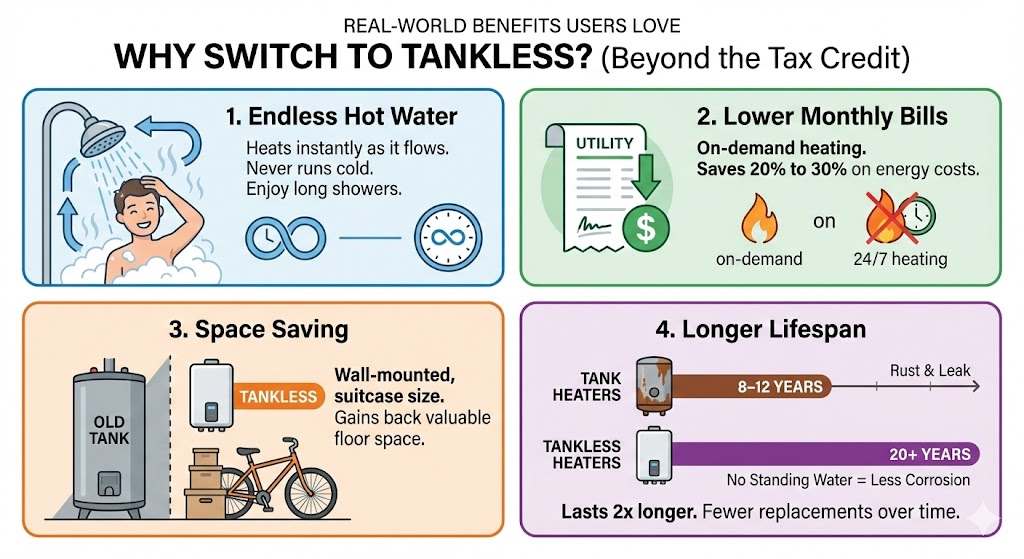
3. Space Saving
A big water tank takes up a huge square in your garage or basement. A tankless unit is the size of a carry-on suitcase and mounts on the wall. You gain back valuable floor space for storage.
4. Longer Lifespan
- Tank Heaters: Last 8-12 years. (They eventually rust and leak).
- Tankless Heaters: Last 20+ years. Because they don’t hold standing water, they don’t corrode as fast. This means you buy fewer water heaters over your lifetime.
Is It Worth It? The Financial Math
Let’s be honest that tankless units cost more upfront but doing the math shows it makes sense for many homeowners. If you look at the scenario of replacing an old 50 gallon tank a standard replacement costs about $1,500 while a tankless unit costs around $3,500 due to piping upgrades which leaves you paying $2,000 more in the beginning.
However you can subtract the $600 tax credit from that cost and add in the energy savings of approximately $150 per year on gas. The real value comes from longevity because the tankless unit lasts 20 years whereas the tank only lasts 10 years meaning you would have to buy a second standard tank in a decade.
Over a 20 year period the tankless unit is actually cheaper because you avoid buying a replacement and save thousands in gas bills while the tax credit helps bridge the initial price gap.
How to Buy the Right One (Buying Guide)
When you call a plumber or look online, do not just ask for “a tankless heater.” You need to be specific to get your tax credit.
Step 1: Check the Fuel Type
Make sure you have a Natural Gas or Propane line. If you are all-electric, switching to gas tankless is very expensive due to adding gas lines. (Stick to Heat Pump Water Heaters if you are electric).
Step 2: Look for the ENERGY STAR Logo
The blue Energy Star sticker is a good first sign, but always check the specs for the UEF rating.
Step 3: Verify the UEF
Ask the dealer or plumber: “Does this model have a UEF of 0.95 or higher?” If they say it is 0.82 or 0.90, say no. It must be 0.95 to get the federal tax credit.
Step 4: Size Matters (GPM)
Tankless units are rated by Gallons Per Minute (GPM).
- Small home (1 bathroom): 6–7 GPM is usually fine.
- Large home (3 bathrooms): You need 9–11 GPM. If you get a unit that is too small, your shower might get cold if someone flushes the toilet or runs the dishwasher at the same time.
Installation: What to Expect
Installing a tankless water heater is not a DIY project for most people. It is dangerous to mess with gas lines and high-voltage electricity if you aren’t a pro.
The Process
- Removal: The plumber removes the old tank and drains it.
- Mounting: They mount the new unit on the wall (inside or outside).
- Venting: This is the hard part. Tankless units need special venting (PVC usually) that goes out the side of your house or up the roof. They cannot always use the old metal vent your tank used.
- Gas Line Upgrade: Tankless units need a sudden burst of gas to heat water instantly. Sometimes, your existing gas pipe is too small (1/2 inch) and needs to be upgraded to a larger size (3/4 inch).
- Electrical: Even gas units need electricity to run the computer board and igniter. You will need a standard outlet nearby.
Warning: The cost of venting and gas line upgrades is why tankless installation costs more than swapping a tank for a tank. Always get 3 quotes from local plumbers.
How to Claim Your Tax Credit (Step-by-Step)
You installed the heater. You are enjoying hot showers. Now, how do you get your money?
You will claim this when you file your federal taxes the following year. (e.g., Install in 2026 -> Claim in early 2027).
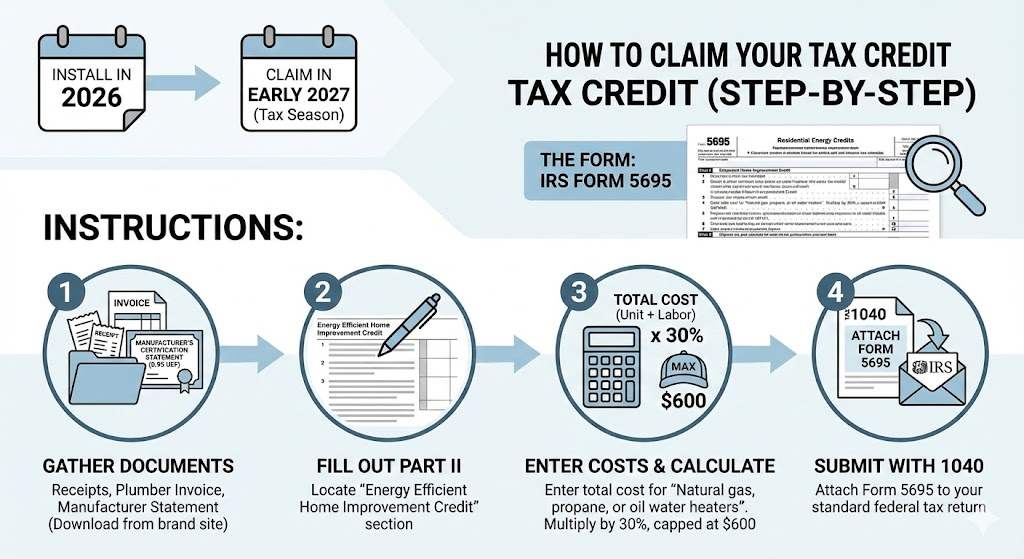
The Form: IRS Form 5695
You need IRS Form 5695 (Residential Energy Credits).
Instructions:
- Gather Documents: Keep your receipt for the water heater and the invoice from the plumber. You also need the “Manufacturer’s Certification Statement” (usually downloadable from the brand’s website like Rinnai, Rheem, or Navien) that proves the unit is 0.95 UEF.
- Fill Out Part II: Look for the section labeled “Energy Efficient Home Improvement Credit.”
- Enter Costs: Enter the total cost (unit + labor) in the line for “Natural gas, propane, or oil water heaters.”
- Calculate: The form will walk you through multiplying that number by 30% and capping it at $600.
- Submit: Attach this form to your standard 1040 tax return.
Beyond Federal: Local Rebates
Disclaimer: We are not tax pros. Always double-check with your CPA or tax software (like TurboTax or H&R Block) to ensure you are filling it out correctly.
Beyond Fe
The $600 federal credit is great, but did you know you might be able to double or triple your savings?
Many local utility companies (the people who send you your gas bill) offer their own rebates. They want you to use efficient equipment so they don’t have to build new power plants.
How to find them:
- Go to EnergyStar.gov/rebate-finder.
- Type in your Zip Code.
- Look for “Water Heater” rebates.
Example:
- Federal Credit: $600
- Local Gas Company Rebate: $300
- State Energy Rebate: $200
- Total Savings: $1,100
Always check this before you buy, as some local rebates require you to use specific installers.
Conclusion: Is Now the Time to Switch?
If your current water heater is more than 10 years old it is living on borrowed time and waiting until it bursts forces you to panic buy whatever inefficient tank is available. By planning ahead and switching to a tankless water heater now you can stop paying to heat water you do not use while enjoying endless hot water and claiming up to $600 back from the federal government. The tankless water heater energy credit is a win for homeowners but to ensure you get the maximum benefit you should consult with an authority like New Flow Plumbing. You should check the age of your unit today and if it is old contact New Flow Plumbing for a quote on a 0.95 UEF Gas Tankless Unit that specifically qualifies for the credit and local utility rebates. Do not leave free money on the table when you can upgrade your home comfort and savings today with the right professional guidance.

Arman Grigoryan
Founder & President of New Flow Plumbing
Arman Grigoryan is the founder and president of New Flow Plumbing, proudly serving Los Angeles, Sacramento, and surrounding areas. With extensive experience in plumbing diagnostics, he leads a skilled team specializing in advanced sewer and drain camera inspections to quickly identify problems and deliver lasting solutions. Arman is dedicated to using the latest technology to provide reliable service, honest answers, and dependable results for every customer.