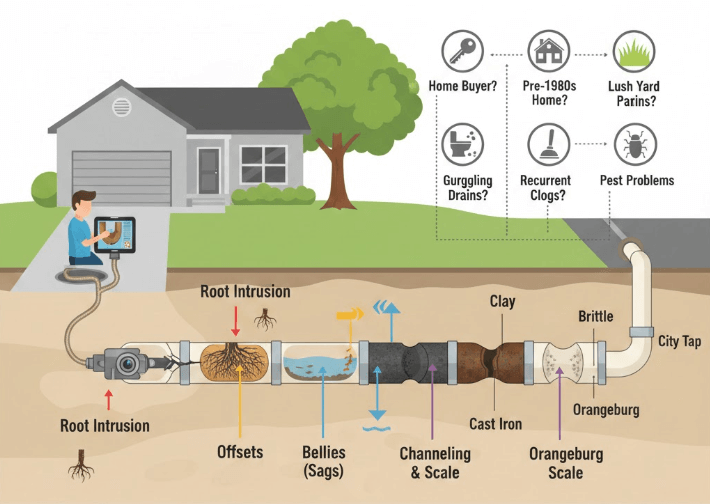
A sewer scope inspection is a diagnostic procedure where a specialized video camera is snaked through your home’s main sewer line to visually assess the condition of underground pipes. It acts as an MRI for your plumbing, allowing you to see critical infrastructure buried 4 to 8 feet deep that standard home inspections completely miss.
Most homeowners assume that if the drains are flowing today, the pipes are fine. This is a dangerous assumption. Sewer lines rarely fail overnight, they fail over decades of slow, silent degradation.
How the Inspection Actually Works
The process is surprisingly non-invasive, yet technically sophisticated. You don’t need to dig up the yard to see what’s going on.
A professional technician accesses the sewer line through a cleanout – usually a capped pipe located in your basement, garage, or front yard. If a cleanout isn’t accessible, they may go through a roof vent or pull a toilet (though this is less common for a standard scope).
They insert a specialized, flexible rod with a high-resolution, self-leveling waterproof camera on the tip. As they feed the camera through the pipe, it transmits a live video feed to a monitor held by the technician. This isn’t a grainy, black-and-white shadow puppet show; modern scopes provide clear, color footage.
The camera travels from the access point all the way to the city tap – the point where your private responsibility ends and the municipal sewer system begins. Along the way, the technician records it, noting the distance (footage counter) and identifying any anomalies.
Do You Really Need One?
If you are asking yourself if you need this, the answer is almost statistically “yes”, but the urgency depends on your situation.
1. The Home Buyer’s Critical Window
If you are in the process of buying a home, a sewer scope is non-negotiable. Standard general home inspections do not cover the inside of sewer pipes. The home inspector will flush the toilet and run the water, if it drains, they mark it as “functional”.
However, a pipe that is 90% blocked by tree roots will still drain water during a 20-minute inspection. It will not back up until you move in with your family and start doing three loads of laundry in a row. Buying a home without a sewer scope is gambling with a potential $5,000 to $20,000 repair bill before you’ve even unpacked your boxes.
2. The Age Factor
- Pre-1980s Homes: If your home was built before 1980, you likely have clay or cast iron pipes. These materials have a lifespan. Clay is brittle and susceptible to roots; cast iron corrodes from the bottom out.
- Post-1980s Homes: You likely have PVC (plastic). While durable, plastic pipes are prone to poor installation, such as crushing or sagging.
3. The “Mystery” Symptoms
You should book an inspection immediately if you notice:
- Gurgling sounds: If your toilet bubbles when the washing machine drains, air is trapped somewhere in the line.
- Recurrent clogs: If you have to plunge your toilet once a month, that is not normal.
- Lush patches in the yard: If one strip of grass is greener and taller than the rest, your sewer line is essentially fertilizing your lawn with raw sewage.
- Pest problems: Rats and roaches live in sewers. If they are getting into your home, they might be using a crack in your sewer line as a front door.
What the Camera Sees
When the camera goes down the line, the technician is looking for four specific structural failures. Understanding these helps you interpret the results and understand the value of the inspection.
1. Root Intrusion
Trees are relentless survivalists. If there is a tiny crack in your sewer pipe – even the size of a hair – roots will find it. They sense the moisture and nutrients inside the pipe. Once a tiny rootlet enters, it grows. As it expands, it widens the crack, allowing more roots in. Eventually, a “root ball” forms, acting like a net that catches toilet paper and grease until the flow is completely blocked.
The Fix: Minor roots can be hydro-jetted (power washed) out. Major intrusion usually requires replacing that section of the pipe.
2. Offsets
The ground moves. The earth beneath your home shifts due to settling, earthquakes, or hydration changes in the soil. When the ground shifts, sections of the pipe can become misaligned. Imagine two paper towel rolls taped together; if you push one down an inch, you create a “lip” or step.
Waste hits this lip and stops. Over time, solids pile up against the offset, causing a blockage. Furthermore, offsets are entry points for dirt and rocks.
3. Bellies (Sags)
Sewer lines rely on gravity. They must slope downward at a specific angle (usually a quarter-inch drop per foot) to keep things moving. A “belly” happens when a section of the pipe sinks due to poor soil compaction or erosion.
This creates a low spot that holds water, much like a puddle. Water sits in the belly even when no one is using the plumbing. Solids and grease settle in this standing water, accumulating until they create a blockage. A camera inspection is the only way to identify a belly because the camera head will literally go underwater.
4. Channeling and Scale (Cast Iron)
If you have older cast iron pipes, the bottom of the pipe can rust away. The water creates a channel (a deep groove) at the bottom of the pipe. Eventually, the bottom rots out completely, and waste water drains directly into the soil rather than flowing to the city. This causes sinkholes under your foundation or driveway. “Scale” refers to the jagged rust buildup that snags toilet paper like Velcro.
What Are Most Pipes Made of?
A sewer scope identifies what your system is made of. This is vital information for long-term home maintenance.
- Clay (Terra Cotta): Common in older homes. It is heavy and resistant to chemicals, but it is very brittle. It snaps easily under pressure and has many joints, which are entry points for roots.
- Cast Iron: The standard for decades. It is incredibly strong but susceptible to rust. It has a rough lifespan of 50–70 years. If your home was built in the 50s and still has original iron, you are on borrowed time.
- Orangeburg: This is the one you dread. Used during WWII due to metal shortages, Orangeburg is essentially wood pulp pitch (tar paper) compressed into a tube. It was never meant to last 60 years. It deforms under pressure, turning from a round circle into a squashed oval. If a scope reveals Orangeburg, the only solution is total replacement. It cannot be repaired.
- PVC/ABS (Plastic): The modern standard. Smooth, joint-free, and impervious to roots (unless cracked). However, plastic is flexible. If the installers didn’t pack the dirt correctly underneath it, it will sag and belly.
Cost vs Reward
Let’s address the financial aspect.
The Cost of Inspection: A standalone sewer scope usually costs between $125 and $300. If you bundle it with a general home inspection, you might get a discount.
The Cost of Ignorance: If you skip the inspection and the sewer line collapses three months later, the costs are staggering.
- Excavation: You have to dig up the pipe. If the pipe runs under your driveway, you are jackhammering concrete. If it runs under your prizewinning rose garden, the roses are gone.
- Repair: Replacing a main sewer line costs anywhere from $3,000 to $25,000.
- Remediation: If the sewage backs up into your basement, you are looking at replacing flooring, drywall, and sanitizing the area.
Spending $200 to identify a $10,000 – $30,000 problem gives you leverage. If you are buying a home, you can ask the seller to fix it or lower the price. If you already own the home, catching a small root intrusion early (a $300 cleaning) prevents a total collapse later. The ROI (Return on Investment) on a sewer scope is higher than almost any other maintenance task.
How Often Should You Look?
You do not need to scope your sewer every year.
- For New Homeowners: Do it before you close the deal. Period.
- For Owners of Older Homes (Pre-1980): A good rule of thumb is every 18 to 24 months. This allows you to catch root growth before it becomes a blockage.
- For Owners of Newer Homes: Every 5 to 10 years is generally sufficient, unless you notice symptoms like slow drains.
- After Major Vegetation Changes: If you just removed a massive tree from your front yard, scope the line a year later. Roots often go into “survival mode” and grow aggressively after the tree is cut, or the dying roots may shift the soil, impacting the pipe.
Can You DIY This?
In the age of YouTube, the temptation to rent a camera and do it yourself is strong. Hardware stores do rent inspection cameras. However, this is rarely a good idea for several reasons.
- Equipment Quality: Rental cameras often lack the self-leveling heads and high-definition resolution of professional gear. Without self-leveling, the video spins as the cable twists, making it impossible to tell if the water is at the bottom or the side of the pipe.
2. Interpretation: Seeing a shadow on a screen is one thing, knowing if it’s a harmless stain or a structural fracture requires training. A novice might panic over a spiderweb or miss a critical hairline crack.
3. The “Stuck” Factor: Professional plumbers know the “feel” of a pipe. If you force a camera head past a bad offset, you might get it stuck. Now you have a blocked sewer line and a $3,000 piece of rental equipment buried in your yard.
What to Look for in a Service Provider
When you decide to book a scope, not all providers are equal. You want a company that specializes in flow solutions, not just a handyman with a camera.
You need a report that includes:
- A link to the video footage (cloud-based or a physical drive).
- Written notes on the type of material (Clay, PVC, etc.).
- Specific distances marked for any issues (e.g., “Root intrusion at 42 feet”).
This is where expertise matters. Companies that focus specifically on plumbing flow and drainage, like New Flow Plumbing in Van Nuys, understand the nuance of what they are seeing. They don’t just identify the problem; they can contextualize the severity. Is that belly in the pipe a “fix now” emergency, or a “monitor annually” situation?
There is a difference between a technician who just wants to sell you a repair and one who acts as a consultant for your home’s health. Using a trusted name ensures that the footage you get is honest and the recommendations are based on engineering reality, not sales quotas.
The Peace of Mind Factor
There is a distinct psychological weight to homeownership. You worry about the roof leaking during a storm. You worry about the furnace dying in winter. A sewer scope removes one of the heaviest weights from that list.
Knowing your sewer line is clear allows you to live differently. You don’t wince when you flush the toilet. You don’t panic when the shower drains a little slowly. You have proof that the infrastructure of your home is sound.
If the inspection does find an issue, it is not bad news – it is empowering news. It transforms a potential midnight catastrophe into a manageable, scheduled maintenance project. You stay in control of your home, rather than your home controlling you.
The Final Word
Your home is likely the largest investment you will ever make. It is a complex machine of wood, wire, glass, and pipe. While we often obsess over the aesthetics – the paint colors, the landscaping, the kitchen counters – the true value of the home lies in its ability to function safely and cleanly.
The sewer line is the unsung hero of that function. It does the dirty work, day in and day out, without complaint, until it can’t anymore. Don’t wait for the backup. Don’t wait for the sewage in the basement. Be proactive.
If you are buying a home, or if you simply haven’t checked your pipes in a few years, it is time to turn on the light in the dark tunnel beneath your yard. It is a small step that ensures the flow of daily life continues uninterrupted.
FAQs

Arman Grigoryan
Founder & President of New Flow Plumbing
Arman Grigoryan is the founder and president of New Flow Plumbing, proudly serving Los Angeles, Sacramento, and surrounding areas. With extensive experience in plumbing diagnostics, he leads a skilled team specializing in advanced sewer and drain camera inspections to quickly identify problems and deliver lasting solutions. Arman is dedicated to using the latest technology to provide reliable service, honest answers, and dependable results for every customer.