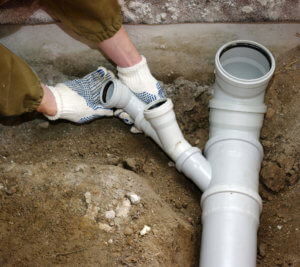
Do you want to know the benefits of replacing cast iron pipe with PVC? You’re in the right place! This article gives you eight strong reasons why PVC is a viable option for replacing rusting or old pipes. We also introduce you to something called trenchless sewer repair, another reliable replacement method.
8 Benefits Of Replacing Cast Iron Pipe With PVC
Here is the revised section. I have removed the dash separators and quotation marks, keeping the format clean and the content high-value.
8 Benefits Of Replacing Cast Iron Pipe With PVC
Cast iron plumbing systems installed mid-century are reaching a critical failure point known as the end of useful life. As these pipes corrode from the inside out, replacing them with Polyvinyl Chloride (PVC) offers superior structural and financial advantages.
1. Lightweight And Safer Installation Cast iron is incredibly dense, often requiring teams of plumbers and heavy machinery to maneuver. PVC is a fraction of the weight, allowing for manual transport into hard-to-reach crawl spaces or basements. This reduces the risk of on-site injury and significantly speeds up the staging and installation process.
2. Cost Efficiency In Material And Labor The price per linear foot of PVC is significantly lower than cast iron. However, the biggest savings come from labor reduction. Because PVC is easier to cut, maneuver, and join, projects that would take days with cast iron can often be completed in a fraction of the time, drastically reducing billable labor hours.
3. Soil Shifting Flexibility Rigid pipes fail when the earth moves. PVC is designed with a specific modulus of elasticity that allows it to bow and flex with natural ground settling or seismic activity without snapping. This flexibility makes it the standard requirement for areas with expansive soil (clay) or heavy traffic vibration.
4. Fracture Resistance Cast iron is brittle; when subjected to pressure spikes or physical impact, it cracks. PVC is engineered to absorb impact and withstand high-pressure loads. It bends rather than breaks, maintaining structural integrity in environments where rigid materials would suffer shear breakage.
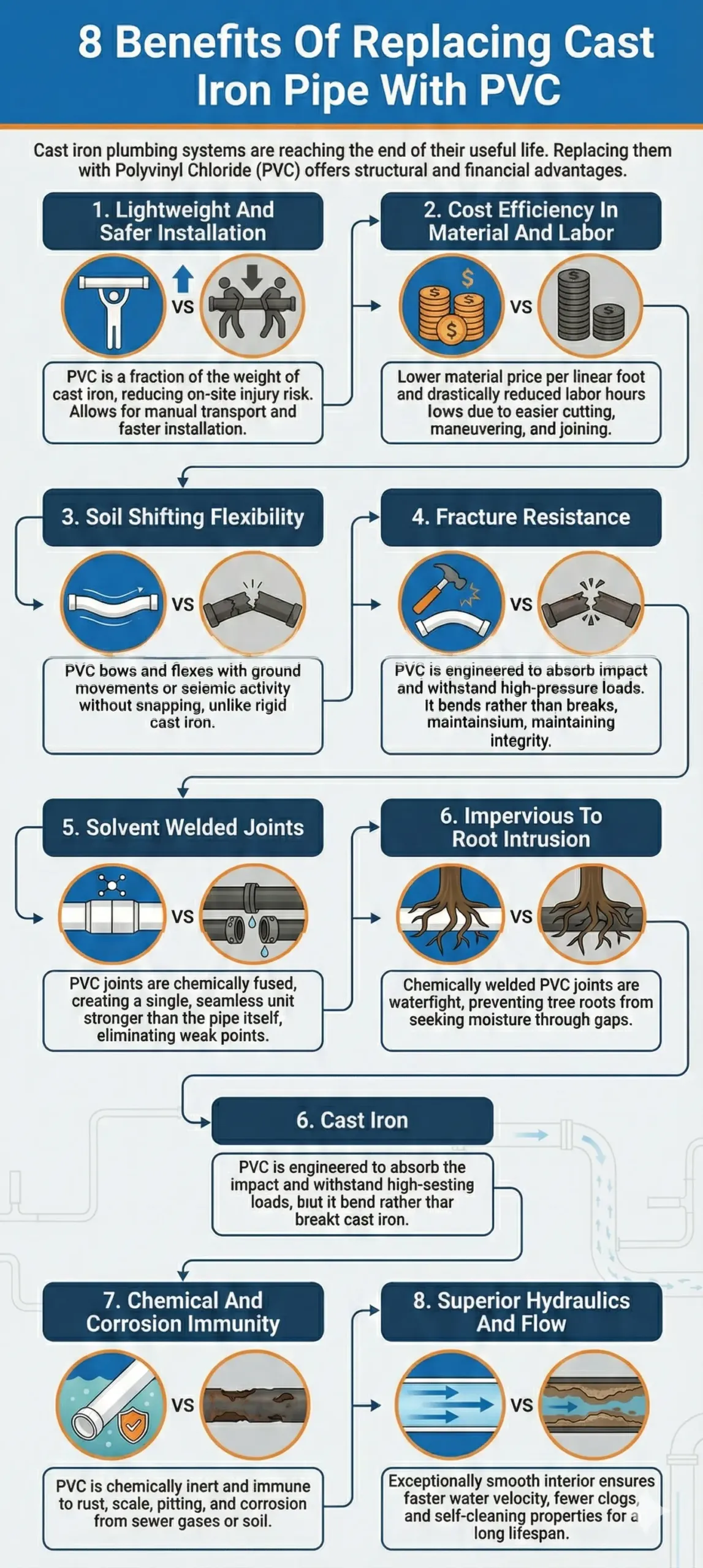
5. Solvent Welded Joints Unlike cast iron, which relies on mechanical couplings that can loosen over time, PVC joints are chemically fused using primer and solvent cement. This process creates a single, seamless unit. The bond at the joint becomes stronger than the pipe itself, eliminating the weak points inherent in older piping systems.
6. Impervious To Root Intrusion Tree roots are the leading cause of sewer line blockage. They seek moisture through the microscopic gaps in cast iron and clay pipe joints. Because PVC joints are chemically welded (fused together), they are completely watertight. Without a seam to penetrate or moisture leaking out to attract them, roots cannot enter the system.
7. Chemical And Corrosion Immunity Cast iron pipe deterioration is often accelerated by hydrogen sulfide gas (sewer gas) which creates sulfuric acid, eating the pipe bottom known as channel rot. PVC is chemically inert. It is immune to acids, bases, and salts, meaning it will never rust, scale, or pit. Modern PVC installations have a projected lifespan exceeding 100 years.
8. Superior Hydraulics And Flow Cast iron suffers from tuberculation, the buildup of rust scale that narrows the pipe interior and slows drainage. PVC has an exceptionally smooth interior (a low Manning’s roughness coefficient). This ensures faster water velocity, fewer clogs, and a pipe that remains self-cleaning for its entire lifespan.
Read more about: Are Cast Iron Drain Pipes Still Useful?
Should You Combine Or Connect Cast Iron With PVC?
The short answer is no. It’s not recommended. Even if you did it yourself, you would need a unique tool to cut the cast iron. Let’s say you only need to replace a section of crumbing pipe with something brand new. The connecting ends
If the pipe is somewhere under your home, you will be chipping away concrete and tile, searching for a minor problem, ending up with a huge mess. Cast iron plumbing is becoming outdated, and almost all of them need total replacement before total failure.
Other Replacement Options
Replacing your cast iron pipes with PVC may seem like a simple switch, but that’s not always the case. Here are our top replacement options.
Pipe Lining (Trenchless)
A unique, epoxy-impregnated liner is inserted into the old pipe, inflates, and creates a new pipe structure directly inside the old one. Pipe lining can be considered replacement or repair depending on whether the whole pipe length will be lined or just a section.
If only a section of pipe (a spot repair) is lined, it is considered a repair. If you line the whole pipe from start to finish, it is basically like getting a brand new pipe installed (aka replacement).
Pipe Bursting (Trenchless)
Pipe bursting is where a new HDPE (high-density polyethylene) pipe is attached to a winch with a cone-shaped bursting head and pulled through the damaged line. The damaged pipe breaks apart as the new one takes its place.
Note: Sometimes, a drain pipe is so severely damaged that no trenchless method is viable. Plumbers cannot use trenchless technology on pipes that are back-pitched, which means that the original contractors failed to use the proper slope for your sewer line to your city connection. If the pipe has collapsed onto itself, you will have to go the conventional trenching route.
The Cost Of Replacing Cast Iron Pipe
Trenchless sewer repair can cost anywhere between $4,000-$15,000 for the average single-family home. Jobs range from a few feet of repair to hundreds of feet, changing the pricing per amount of needed work. There will always be a base cost starting at permits, contractor mobilization, project minimums, and then prices move on from there.
Conventional sewer repair, on average, costs $50 to $450 per linear foot. The price to install brand new pipes throughout your home or yard could run to $15,000 because of all the extensive work, such as trenching and excavation. Conventional sewer repair quotes will be lower than trenchless, but they don’t include the cost to clean up the mess and repair the property damage.
Read also: Signs of broken cast iron sewer pipes

Who Can Replace Cast Iron Pipe Near You
It’s time that New Flow Plumbing comes in to save the day. We’ll get you started with a CCTV sewer camera inspection to determine where your problems come from. Then, we give you a free repair estimate, followed by available repair options. Whatever the issue, New Flow Plumbing will have your plumbing running perfectly again.
FAQs

Arman Grigoryan
Founder & President of New Flow Plumbing
Arman Grigoryan is the founder and president of New Flow Plumbing, proudly serving Los Angeles, Sacramento, and surrounding areas. With extensive experience in plumbing diagnostics, he leads a skilled team specializing in advanced sewer and drain camera inspections to quickly identify problems and deliver lasting solutions. Arman is dedicated to using the latest technology to provide reliable service, honest answers, and dependable results for every customer.