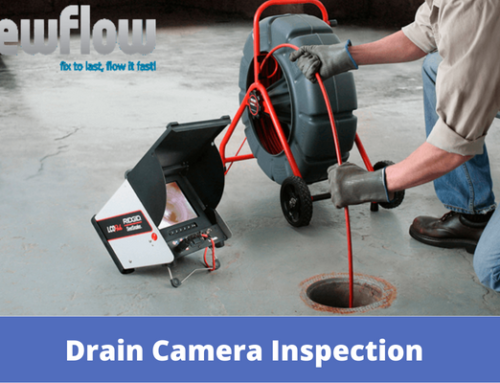
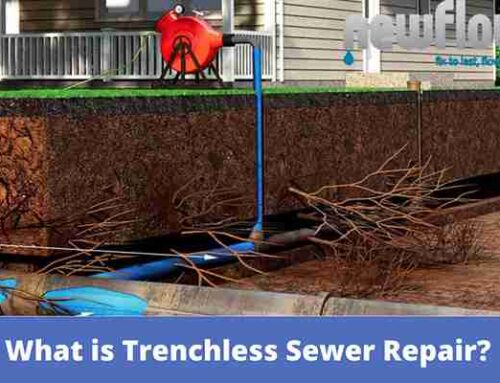
Yes, cast iron drain pipes are still extremely useful and often superior to modern plastic options due to their strength and ability to block noise. Unlike thin PVC pipes that let you hear every flush and trickle through your walls, cast iron is dense and silent, providing a quieter home environment. While pipes in pre-1970s homes may eventually suffer from rust or tree root intrusion, you don’t always need to replace them; modern trenchless technology can often repair these pipes from the inside without digging up your floors, extending their 50 to 100-year lifespan without the mess.
What Is Cast Iron?
Cast iron is a metal alloy made of iron, carbon, and silicone. Cast iron is not malleable, meaning it cannot be hammered or pressed into shape, so it’s cast in a mold before being installed.
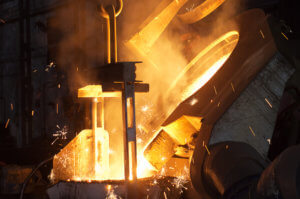
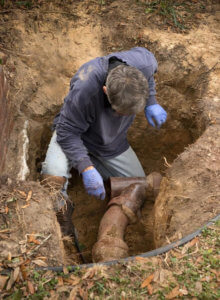
Cast iron drain pipes are molded before being installed.
Does Your House Have Cast Iron Drain Pipes?
Most homes built before the 1970s were made with cast iron for water and sewage pipes.
If your home was built before then, you may be noticing signs that the pipes have reached their effective lifespan. Cast iron can last 50 to 100 years but a home built in the ‘20s and ‘30s are reaching their end.
Keep in mind that cast iron can last their whole lifespan but several circumstances can affect its longevity.
Below are the advantages and disadvantages of cast iron drain pipes.
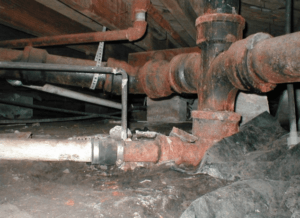
Cast iron drain pipes can be found in most homes built before the ’70s.
Advantages of Cast Iron Drain Pipes (How Modern Still Works)
50 to 100 years of use.
Cast iron pipes were built to last but several factors can cut into their lifespans such as weather, tree roots, types of soil, and water quality.
It’s durable and able to withstand heavy loads and high pressure.
Consider another use for cast iron such as pots and pans. Those never seem to go bad with proper care.
Cast iron deadens the sound of flowing water and sewage.
-
- Cast iron is very dense and difficult to vibrate, creating less noise than PVC. You can only hear it if you put your ear against the pipe.
- PVC is not dense and will rattle and shake as water passes through. You can even hear your upstairs neighbors pipes as they flush.
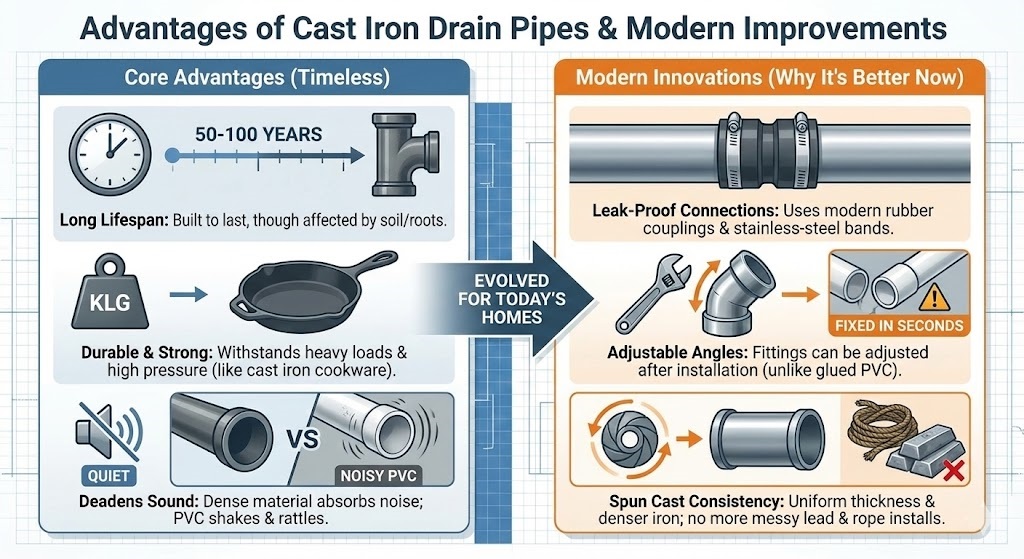
Modern Cast Iron Drain Pipes
- New cast iron pipes are better than ever. They use rubber couplings and stainless-steel band clamps to make leak-proof connections.
- You can make adjustments to fitting angles (curves and bends) after installation. With PVC, you only have seconds to adjust once it’s glued.
- Old cast iron was a chore to install involving oil-soaked ropes and melted lead ingots. What a hassle!
- Modern cast iron is spun cast (meaning they’re spun while being molded), so the pipe wall thickness is more consistent and produces a denser iron.
Disadvantages of Cast Iron Drain Pipes
Cast iron was meant to last with proper maintenance. Unfortunately, there’s no way to truly care for pipes that run underground or inside walls (as you would a cast iron pan). Several problems can arise over time and you may notice the signs below.
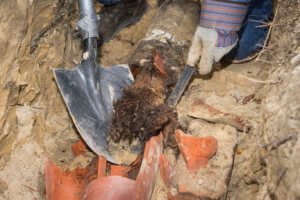
Tree roots can destroy old pipes such as cast iron and terracotta.
- Leaks
- Leaks can be caused by cracks or damage from sulfuric acid (or other corrosive materials like drain cleaners) in your pipes. Call us at New Flow Plumbing and we can find the source of the issue.
- Odor
- Sewer systems are designed to be airtight. If you can smell sewage, it can be a sign of a cracked sewer pipe. Inhaling sewer gas for too long can lead to health problems.
- Backups
- Slow draining and clogs can be a sign your pipes are failing. Even cleaning products contain sulfuric acid which is damaging to cast iron pipes.
- Mold
- Mold can begin to grow due to increased humidity in your home. A cracked pipe will heat your home and create the right mold growth conditions.
- Strange lawn signs
- Leaking sewage acts as a fertilizer and your grass can show signs of extreme growth or a lush green color.
- If you notice puddles of water or sewage waste in your yard, you can be certain a pipe is cracked and leaking.
- Your soil can sink, develop strange bumps, or even gutters due to soil dissipating.
- Cracks
- Leaking pipes can disrupt your foundation and cause walls, floors, or ceilings to crack. Call a foundation repair specialist if the situation gets this bad.
- Rodents or insects
- Rodents and insects (cockroaches, palmetto bugs, and flies) can find their way through even the tiniest of cracks, and make their way into your home.
- Pest control can kill the current invaders but more will come if the root of the problem is not handled.
Well, How Do You Replace Cast Iron Pipes? (We Can Help with That)
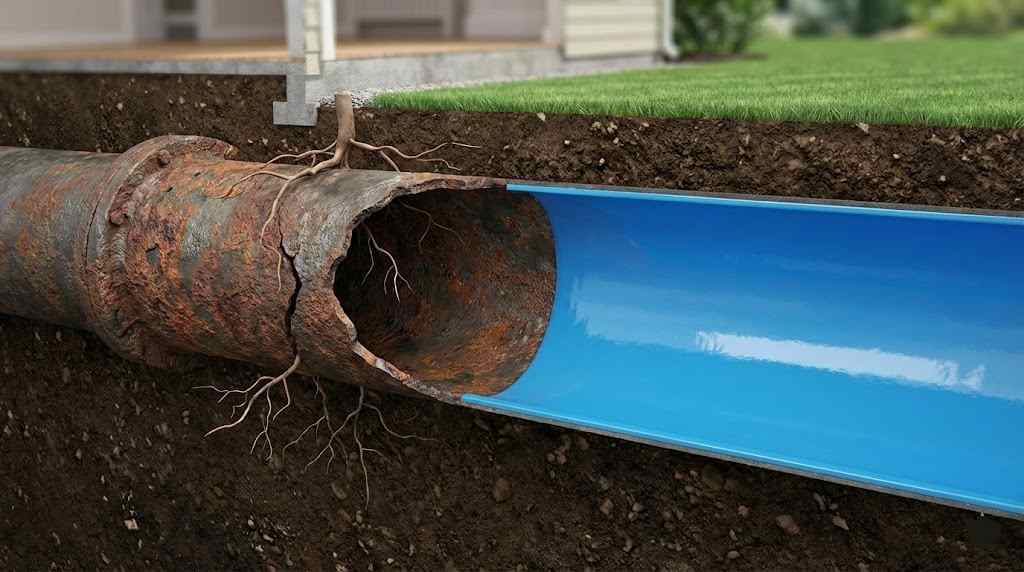
Trenchless sewer repair is one way of replacing old cast iron pipes.
Trenchless sewer repair is how we can fix damaged pipes without costing you thousands in clean up and repair. Conventional pipe replacement can require tearing and ripping up your house or yard. Walls and floors will have to be replaced using this method, making your life difficult. Trenchless technology only involves finding two access points. For example, we can dig one 4ft by 4ft pit for one and remove a toilet for the other. Simple as that!
Trenchless sewer repair is cost-effective, time-saving, and lasting solution. 50 – 100 years of efficient results. The life-use expectancy for HDPE (high-density polyethylene) pipes is 100+ years. CIPP (cured-in-place pipe) has 50-year life-use expectancy.
After we take a CCTV inspection of your pipes, we at New Flow Plumbing can take the best route based on the situation. Below are the ways to get your plumbing back to normal.
- Pipe Lining
After inspection, we insert an epoxy-impregnated liner into the old pipe. Inside the liner is another layer called a bladder, which will inflate and press the epoxy against the pipe. After a few hours the epoxy cures and BOOM! You have a new pipe within your old one.
Note: The pipe’s diameter does become slightly smaller but it increases your new pipe’s flow capacity.
- Pipe Bursting
Pipe bursting is another method we can take for lateral lines or the house-to-street sewer lines. If the pipe has lost its shape or structural integrity, we will dig our two 4ft by 4ft pits (one on each end of the pipe) and feed in a new pipe that breaks up the old one as it moves along, taking its place. We perform another CCTV inspection to ensure everything is perfect and then fill in the access pits.
When it’s impossible to use a trenchless repair method, we use conventional sewer replacement methods. Nonetheless, contact us and we can find the solution that works for you!